
About this site
What is evidence-based veterinary medicine (EBVM)?
EBVM can be defined as the making of decisions which combine clinical expertise with the most relevant and best available scientific evidence whilst taking into account each patient and owners’ individual circumstances (RCVS Knowledge, 2024). Ultimately as veterinarians, we wish to do the best for our patients and support them to have as long and happy lives as possible. Having the best quality evidence as the basis for all of our decisions would be ideal, but as in human medicine, it may not exist. A search for the best available evidence or conducting your own research into the evidence are the alternatives.
What are the obstacles to practising EBVM?
Time
Access to literature
Difficulty in analysing articles
What this site is …
This site is a repository of freely available articles from across the web that will hopefully give guidance to veterinarians in their day-to-day practice. It includes consensus statements, clinical guidelines, critically appraised topics and some systematic reviews.
The site is updated monthly and is a work in progress. Additionally, if that new information supersedes previous statements, the latter will be removed.
Links are provided to all the articles so that they may be read in full. There are also buttons for downloading each article (if available). Information is organised by body system or subdiscipline, as opposed to by the issuing organisation.
All doses of all drugs should be double-checked.
What this site is not …
- Exhaustive
- All the answers
- Necessarily the best evidence for your situation
- Responsible for the treatment choices you make for your patient and client
Methodology
Every month, organisational websites (listed below) are searched for new or updated articles. This is achieved by the author (JC) primarily receiving content alerts, but if these are not available, by directly accessing websites.
Inclusion at present is quite broad, but a minimum is that articles are added if authored by a group of experts in their field and a joint statement or consensus is reached. The articles are also chosen so that they are useful for general or specialist practice. Narrative reviews and those that have sparked considerable controversy once released are not included, with a few exceptions (with notes). Anything that is not open access is not included.
The following websites and journals are regularly accessed:
- American Animal Hospital Association – Clinical guidelines
- American College of Veterinary Internal Medicine – Consensus statements
- Companion Animal Parasite Council – Guidelines
- European Scientific Counsel Comapnion Animal Parasites – Guidelines
- Feline Veterinary Medicine Association (formerly AAFP) and International Cat Care (formerly ISFM) – Consensus guidelines
- International Committee on Allergic Diseases of Animals – Guidelines
- International Society for Companion Animail Infectious Diseases – Guidelines and Consensus Statements
- International Veterinary Epilepsy Task Force – Consensus Reports
- Journal of Shelter Medicine and Community Animal Health – Guidelines
- Journal of Veterinary Emergency and Critical Care – Consensus statements
- Royal College of Veterinary Surgeons – Knowledge – Veterinary Evidence Clinical Queries
- University of Copenhagen International Veterinary Evidence-based Guidelines Centre – Guidelines
- University of Nottingham: Centre for Evidence-Based Veterinary Medicine – BestBETs for Vets
- World Association for Veterinary Dermatology – Consensus guidelines
- World Organisation for Animal Health – Antimicrobial Use Guidelines
- World Small Animal Veterinary Association – Guidelines
Suggestions for other resources and corrections are welcome. Please email: ebvminpractice@gmail.com
Assessing evidence
There are many options for accessing information, and trying to find the “best” can be difficult. Many veterinarians start with the websites, such as Veterinary Information Network (VIN) or Google, and then hone their search from there. There is the danger here, however, of delving too far into lower quality evidence sources such as individual case reports and expert opinion.
The best evidence comes from evidence-based practice guidelines, consensus statements and systematic reviews. Critically appraised topics on specific questions fit into level 1 (see Figure 1). Textbooks, conference proceedings and pharmaceutical company literature generally fit into level 5.
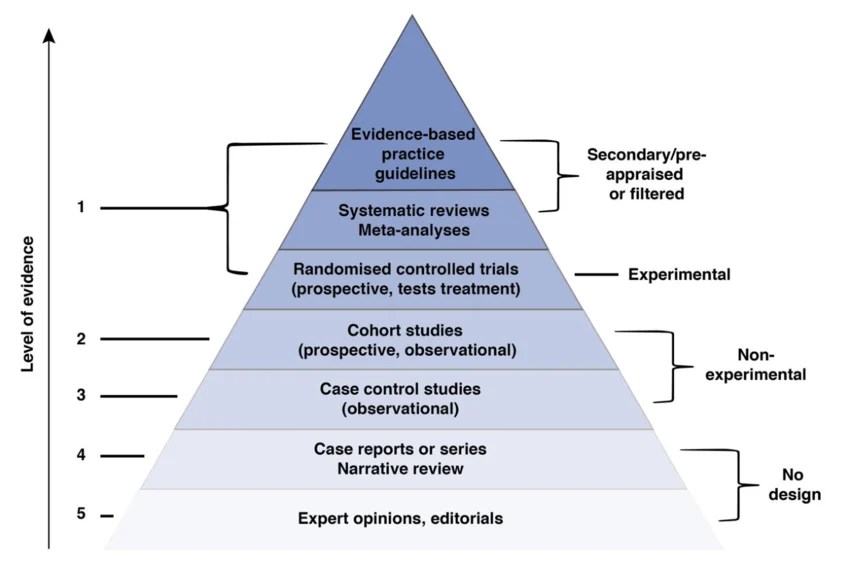
In addition, this site does not currently assess or rank the quality of evidence found in the linked articles. Not all guidelines, consensus statements or critically appraised topics are completely evidence-based. This may be due to a simple lack of good evidence, and therefore having to rely on lower tier evidence. This should be acknowledged, but in many cases, is not. Indeed, if there is no evidence, this also should be noted.
In lieu of this, tools are available for veterinarians to make their own decisions in this setting. Examples include:
The Evidence-Based Veterinary Medicine Association (EBVMA) is a professional organisation founded to better organize the emerging research, training and practice of evidence-based medicine.
What is coming in the future
- Articles available for other species (horses, ruminants, exotics etc.)
- Articles available in other languages
- Assessment of the evidence quality in the articles by independent experts
Website manager
This site is managed by Dr Jim Connah BVSc MVetSci MANZCVS (Small Animal Medicine). I am a small and large animal veterinarian located in Hobart, Tasmania, Australia and I have been in practice for over 30 years. I have a passion for evidence-based veterinary medicine and continued education. I am not, however, an expert in either field.
This site was created as a resource for busy veterinarians who may have a specific question that needs answering. There is so much good quality evidence out there, but many people do not know where to find it. Hopefully this will make things easier.
 EBVM in Practice